Khalili: Women are leading innovative solutions in the water sector despite the challenges.

In partnership with the Water Authority: the "Water and Gender" award
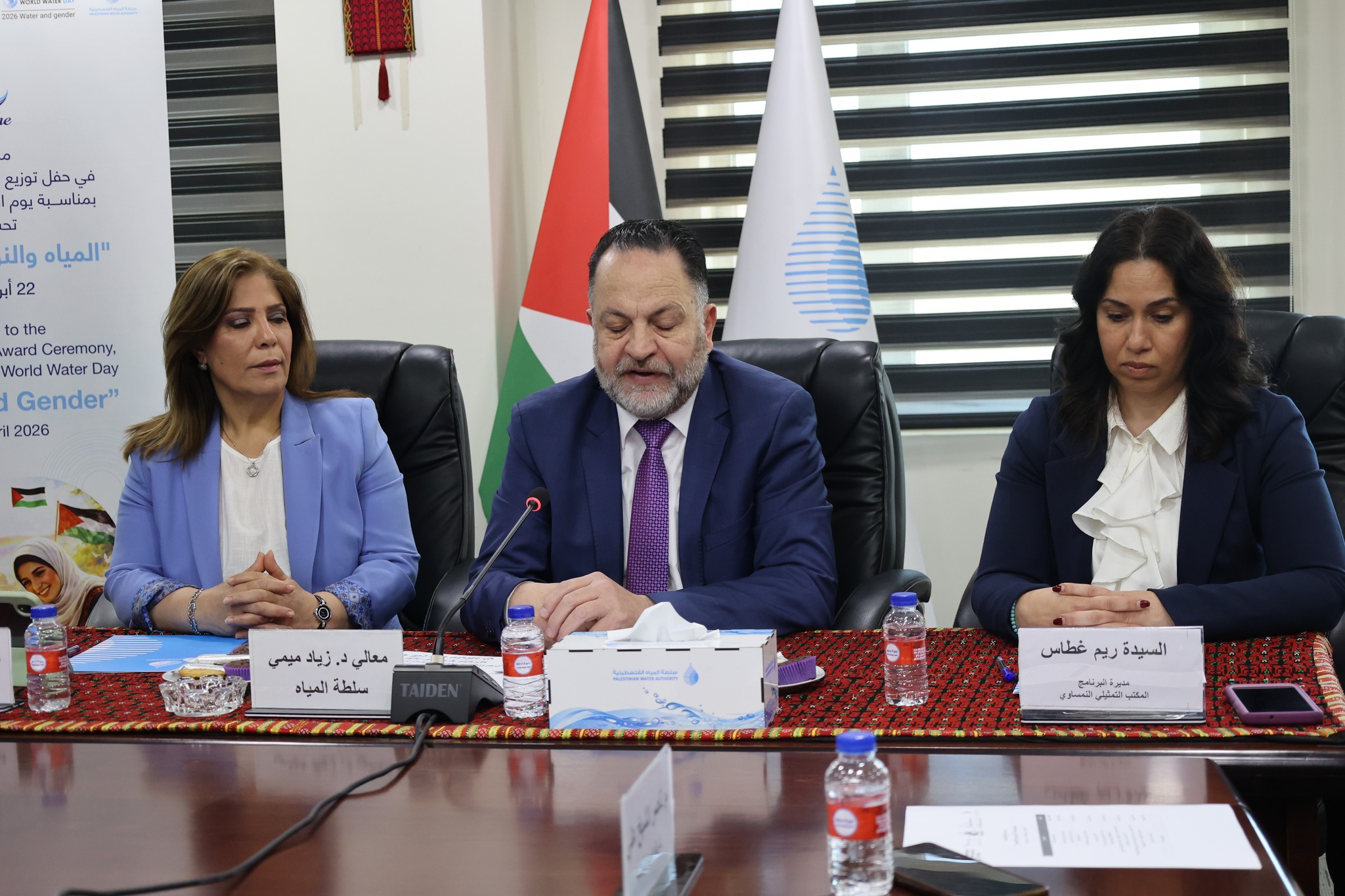
As part of the partnership between the Ministry of Women's Affairs and the Palestinian Water Authority, the Water and Gender Award was presented to pioneering projects and initiatives led by women in the water sector, aimed at supporting women's innovation in the fields of sustainable water management and enhancing the role of women in providing practical solutions to challenges related to water resources. The event was held in the presence of the Minister of Women's Affairs, Ms. Mona Al Khalili, and the head of the Palestinian Water Authority, His Excellency Dr. Ziad Maimi, alongside representatives of partner institutions, including Ms. Reem Ghattas, Program Director at the Austrian Representative Office, and Mr. Omar Domboya, Head of the Water, Sanitation, and Hygiene (WASH) sector at UNICEF.
The head of the Water Authority, Dr. Ziad Al-Maimi, in his speech during the ceremony, stated that this award "is not just a platform for recognition, but a real space to highlight women's potential capable of turning challenges into opportunities," pointing out that the submitted projects reflected an advanced level of innovation linked to reality and provided practical solutions that combine environmental sustainability with the economic and social empowerment of women. He added that the Water Authority is working to support and adopt these initiatives by providing an incubating environment and enhancing partnerships to generalize successful experiences.
The Minister of Women's Affairs, A. Mona Khalili stated that this award represents a clear message that the Palestinian woman is a key partner in development and is capable of providing innovative solutions to face challenges, foremost among them the challenges related to the water sector, which constitutes one of the most important components of life and resilience. She pointed to the structural challenges resulting from the reality of occupation, and the restrictions it imposes on access to water resources, amid the decline in the per capita share of water for Palestinians, and the worsening crisis in Gaza Strip where more than 95% of the groundwater is unfit or suitable for drinking. She added that the presented initiatives reflected an awareness of the importance of sustainable water management through water harvesting, reuse, smart technologies, and community awareness, emphasizing that empowering women in the water sector is a fundamental pillar for achieving sustainable development and promoting justice and equality.
In her speech, Ms. Reem Ghattas, Program Director at the Austrian Development Agency, emphasized the depth of the long-term partnership, particularly in supporting the water sector for over 25 years in the West Bank and Gaza Strip, noting that this sector is one of the priorities of Austrian development cooperation. She emphasized the importance of empowering women and promoting gender equality as a fundamental pillar in development programs, expressing her hope that this award would contribute to supporting pioneering women's initiatives and enhancing women's participation in planning and decision-making, which would positively reflect on local communities and strengthen the sustainability of the water sector.
Mr. Omar Domboya, Head of the Water and Sanitation Sector at the United Nations Children's Fund (UNICEF), also emphasized the importance of integrating the humanitarian dimension into water sector interventions, especially in Gaza Strip. He affirmed that supporting women and empowering them to access innovative solutions directly contributes to enhancing the resilience of families and improving public health conditions, particularly in the most vulnerable environments.
The winners presented short briefs showcasing their projects, which varied between agricultural, technical, awareness-raising, and innovative initiatives in the water sector. The projects included: "My Farm" by Rasila Drat, an agricultural project that relies on water-saving systems and combines agricultural production with educational and tourism aspects, a water leak detection system project by Lynn Nawha, and a project to convert agricultural waste into low-cost solutions for water pollution treatment by Janat Jamal. The projects also included a hybrid water disinfection system for emergency and siege conditions in Gaza by Amal Al-Boursh, the Slope Calc App Project by Mai Attawna, as well as a water consumption management project in a displacement environment by Iman Al-Kurd from Gaza, and the "Qatra Loun" project, which uses art as a tool for awareness and psychological support by Asya Harb. At the end of the event, the winning projects were honored, in recognition of their efforts and innovative initiatives in the water sector, reflecting the role of Palestinian women in enhancing resilience and providing practical solutions to existing challenges.
Related topics
- وزيرة شؤون المرأة: بناء بيئة عمل داعمة للنساء مسؤولية مشتركة
- وزيرة شؤون المرأة تلتقي رئيس بعثة الشرطة الأوروبية وتبحث تعزيز التعاون المشترك
- شؤون المرأة: تزايد أعداد الأسر التي ترأسها النساء في غزة يتطلب استجابة متكاملة تراعي أدوارهن واحتياجاتهن
- وزيرة شؤون المرأة تبحث مع برنامج الأمم المتحدة الإنمائي سبل التعاون والبرامج المشتركة
- The Minister of Women's Affairs meets with the Moon Ladies Group in Jericho and the Jordan Valley.
- The Ministry of Women's Affairs conducts awareness sessions on digital violence in the Ansar area camps in Gaza Strip.
- The Ministry of Women's Affairs conducts awareness and psychological support sessions for women in the shelters in Gaza City.
- Al-Za'eem and Al-Khalili review the gender data and statistics report at the Ministry of Justice for the year 2025.
- Minister of Women's Affairs: Protecting a woman's right in the alimony is protecting the family and promoting social justice.
- Under the patronage of the Prime Minister, the Prime Minister... The Ministry of Women's Affairs grants funds to 45 women's associations to enhance economic empowerment.